SOBRE LA ALIMENTACION DEL BEBE

En mis años de amistad con tantas mamás a lo largo y ancho de todo el mundo, he aprendido que lo que en un país está totalmente prohibido a una determinada edad es lo más común en otro.

Es el caso, por ejemplo del bróccoli, que en muchos libros y páginas web [serias] con recetas para chicos lo usan a partir de los 6 meses y acá no se recomienda hasta después del año, por lo tanto, las recetas que tengo en este blog son para ser usadas de acuerdo con lo que el pediatra indique como posible alimento para cada chico en una determinada edad.
Mostrando entradas con la etiqueta Acompañamientos. Mostrar todas las entradas

domingo, 14 de noviembre de 2010

How to make perfect scrambled eggs


How would you like your eggs? What a question. The eternal struggle between what I want – a creamy pile of golden deliciousness – and what I suspect I'll get – a pallid, quivering mess ­– sucks me in every single time I treat myself to breakfast out. Wimpishly, I generally end up ordering fried instead or, if I'm feeling particularly brave, poached, because nothing brings on a hangover quicker than bad scrambled eggs. Equally, not much beats the lazy, luxurious pleasure of well-cooked ones and, unless you breakfast regularly in smart hotels, they're something best left to slow weekend mornings at home.

Classic eggs

Delia, the queen of eggs, having taught the nation once and for all how to boil them, seems a good place to start. In her Complete Cookery Course, she admits to being a "disciple of Escoffier" on the subject of scrambling, which sounds an uncharacteristically Francophile admission from our homely domestic goddess, but I'm willing to give the good monsieur's method a try on her recommendation.

I heat a "walnut of butter" in a "small solid saucepan over a gentle heat" and whisk two large eggs together with a pinch of salt and pepper. Once the butter is foaming ("whatever you do, don't let it brown" cautions Delia) I pour in the eggs and "stir like mad" with a wooden spoon. When the eggs are almost, but not completely set I take the pan off the heat and add another knob of butter, "which will melt into it as it finishes cooking in the heat of the pan". The results are pleasing: a deep yellow colour, with a rich, buttery flavour, although I like my eggs slightly creamier in texture. Textbook eggs, but not quite velvety enough for my tastes.

Gordon

If anyone knows about poshing up scrambled eggs, it's a Michelin-starred chef, so I turn to Gordon Ramsay for advice. His method is quite different from Delia's – I break the eggs into a cold pan over a very low heat, and add the butter, stirring the eggs frequently until they begin to set; a good six or seven minutes. In goes another knob of butter, there's more stirring (Gordon likens the process to making a risotto), and then, just before they're completely set, I take the pan off the heat and stir in a teaspoon of crème fraîche and season. The whole process has taken over 10 minutes, but the eggs are wonderfully rich and creamy; in fact, they're a little too smooth. Egg sauce doesn't have quite the right texture, however wonderful the flavour.

Bill

The best scrambled eggs in the world are popularly supposed to be served by sunny-faced Australian chef Bill Granger, dubbed by no lesser authority than the New York Times, "the egg master of Sydney". They are, apparently, "divinely creamy" but also "as light as the breath of an angel". This, I have to try.

I heat the "merest sliver" of butter in a non-stick pan over a high heat, and whisk together two eggs, a pinch of salt, and 6 tbsp single cream. After about a minute, I pour in the eggs, and leave them for 20 seconds, my hands twitching on the wooden spoon, then stir them very slowly, gently pushing the sides in to the centre of the pan: Bill tells me to think of them as "folded rather than scrambled eggs".

They're allowed to cook unmolested for another 10 seconds, before I then dive in again with the spoon, and so on, until they're just set, with big, soft curds. Thanks to all that cream, the eggs are pale, and I regret to admit I'm disappointed by them; they're heinously rich, without tasting of much but cream, and I find their famous lightness of texture more akin to an egg mousse than anything I'd trust myself with when I was feeling a bit delicate. Maybe things just taste better in the sunshine.

Slow food

I forget where, but I once read that the scrambled eggs should be cooked so slowly and gently that, for optimum results, a candle would be the ideal heat source. I haven't got the strength of will or arm to stir a pan over a tealight for an hour, but the idea intrigues me, and I decide to try scrambling my eggs in a bowl over a pan of simmering water (as apparently favoured by "the French" according to one online sage). This takes bloody ages – don't bother putting the toast on for at least quarter of an hour – and the results resemble something you might step over outside Wetherspoons after a heavy Friday night. The taste is good, but no better than Gordon Ramsay's, and soured slightly for me by the extra washing up.

Poached

San Francisco chef Daniel Patterson popped up in the New York Times a few years ago excitedly proclaiming he'd discovered a new way of scrambling eggs, after his environmental-lawyer fiancée banished Teflon-coated pans from the kitchen, and he got sick of scraping egg from the new cast-iron set. He decided to whisk them together, and then poach them as one would a whole egg: "I expected that they would act much as the intact eggs did and bind quickly, but I did not expect them to set into the lightest, most delicate scrambled eggs imaginable," he exclaims breathlessly in the article.

I'm suspicious ­– how can eggs cooked without fat of any kind redeem themselves into a decent breakfast? – but I give it a try nevertheless, sieving my eggs, as recommended by Daniel's friend Harold McGee, in order to get rid of the wateriest bit of the whites, given they're not fresh from the farm, beating them together, and then pouring them into a whirlpool in a pan of simmering water. I then cover the pan, count to 20, take a deep breath, and drain them into a sieve. The stuff is distressing to the eye; a weird, scrunched up mass of egg which, even when patted dry with kitchen paper and seasoned with copious amounts of melted butter and sea salt, is barely recognisable as the same foodstuff as I've been cooking all week. One for health fiends only.

Fine tuning

I find a video of Gordon scrambling eggs online, in which he claims that whisking them beforehand is bad (something I'm happy to take on trust, given stirring them together in the pan saves on washing up), and adding salt before cooking "breaks down the eggs, turning them into something very watery". As I don't find retrospective seasoning entirely satisfactory (the salt doesn't seem to blend as well somehow, and I end up adding far more to compensate), I test this, and can detect no difference between the eggs salted during cooking, and those salted afterwards, except the first ones taste slightly better. Perhaps I'm imagining it, but I decide to ignore Mr Ramsay on this one.

I also experiment with different fats: just butter, a la Delia, isn't creamy enough, but both milk and cream leave the eggs slightly loose and watery. Reluctantly, I concede that Gordon's fancy crème fraîche gives the best results; thick, rich, and ever-so-slightly tangy. In a rare concession to health, I deem the second lot of butter unnecessary. I'm still not happy with the final texture of Ramsay's recipe though, so, taking a leaf from Bill Granger's book, I turn up the heat and, after mixing the eggs together in the pan, leave them for a few seconds, then begin to stir, then leave them, and so on. This gives larger curds, which work perfectly with the creamy richness of the eggs.

Great scrambled eggs require a generous hand with the fat, and single-minded devotion to stirring and watching – leave them alone for a second, and they'll overcook. Get someone else to make the toast.

Perfect scrambled eggs

Serves 1

2 large free-range eggs
Knob of butter
Pinch of salt
1 tsp crème fraîche

1. Break the eggs into a small, heavy-based frying pan or saucepan and add the butter and salt. Place over a medium-high heat, and stir the eggs together with a wooden spoon.

2. Once well-combined, leave the eggs for 10 seconds, and then stir again. If they're setting too quickly, take them off the heat to stir and then replace. Repeat until they begin to set, and then stir continuously until they're nearly as cooked as you like them; always take them off the heat before they're done.

3. Whip the pan off the heat, stir in the crème fraîche, and serve immediately.

Are scrambled eggs the king of the breakfast table, and if so, is this the best way to cook them? When bacon and black pudding just doesn't appeal, Huevos a la Mexicana, with tomatoes, chillies and coriander is my favourite variation ­– what's yours?


Fuente: guardian.co.uk © Guardian News and Media 2010

domingo, 26 de septiembre de 2010

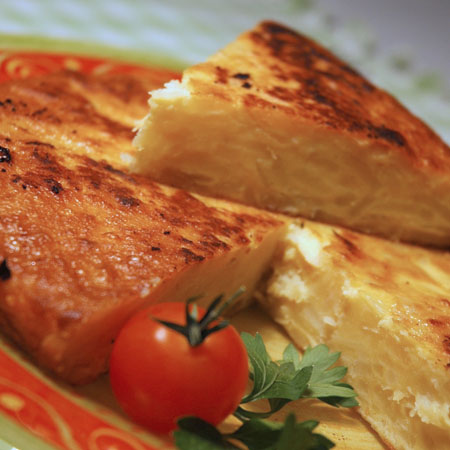
Tortilla de Papas al microondas


A riesgo de que Lobita se ría de mí... como en casa no comemos fritos, siempre me la paso buscando alternativas sanas a los fritos de toda la vida, así fue como di (de igual forma que la receta del Bizcochuelo Express) con esta receta.

A mí personalmente me gusta más que la tortilla tradicional, porque no me gustan las cosas grasosas y pesadas y hecha de esta forma la tortilla queda más liviana. A los nenes directamente jamás les gustó la tortilla y esta les encantó.


INGREDIENTES
  • 1 kg de patatas.
  • 1/2 cebolla picada.
  • 1 cucharada de aceite.
  • 8 huevos batidos.
  • Sal y pimienta a gusto

ELABORACIÓN
En un recipiente para microondas rehogamos la cebolla picada finita con 1 cucharada de aceite durante 2 minutos a potencia máxima. Dejamos en reposo y tapado durante 1 minuto. (Yo no uso aceite, en su lugar uso rocío vegetal de girasol, únicamente para que la comida no se pegue y de todas forma le quede el gustito al salteado.)

Picamos finamente las patatas previamente peladas. Juntamos con la cebolla y cocinamos en el mismo recipiente y tapado durante 10 minutos a potencia máxima, removiendo de vez en cuando.

Posteriormente batimos los huevos y los mezclamos con la patata y cebolla pochada, poniendo a punto de sal. En un molde refractario redondo y de bordes bajos vertemos la mezcla de huevos y patatas. Tapamos con campana o plástico transparente perforado y horneamos en el microondas 6 minutos a potencia submáxima (80% de potencia).

Controlamos la cocción y si es necesario horneamos otros 2 minutos. Si se prefiere la superficie dorada, horneamos sin tapar en el modo combinado (micro y grill).


Fuente: Eroski Consumer

♥
♥

miércoles, 26 de mayo de 2010

Tomates asados con queso


Tiempo de preparación: 5 min.
Tiempo total: 17 min.
Rinde: 4 porciones


INGREDIENTES
  • 4 tomates roma, cortados por la mitad a lo largo
  • 1/4 taza de aderezo italiano fuerte reducido en grasa KRAFT Light Zesty Italian Dressing
  • 1/2 taza de queso mozzarella parcialmente descremado, de baja humedad y desmenuzado KRAFT Shredded Low-Moisture Part-Skim Mozzarella Cheese
  • 2 cucharadas de queso parmesano rallado KRAFT Grated Parmesan Cheese
  • 1 cucharada de hierbas frescas picadas (albahaca, cebollinos y/o perejil)


PROCEDIMIENTO

Calienta la parrilla a fuego medio-alto.
 
Pon los tomates, con la cara cortada hacia arriba, en un molde de aluminio cuadrado de 8 pulgs, engrasado. Rocíalos con el aderezo; espolvoréales los quesos. Coloca el molde sobre la parrilla.
 
Asa los tomates de 10 a 12 min. o hasta que los quesos estén derretidos y los fondos de los tomates, dorados.
 
Espolvorea los tomates asados con las hierbas.

  
ALTERNATIVAS
 
** Prepáralos con vinagreta balsámica KRAFT Balsamic Vinaigrette Dressing.
** Prepáralos usando tomates pequeños madurados en la mata.
 
 
INFORMACIÓN NUTRICIONAL (por porción)
Calorías 80
Grasa total 4.5 g
Grasa saturada 2.5 g
Colesterol 10 mg
Sodio 410 mg
Carbohidrato 4 g
Fibra dietética 1 g
Azúcares 3 g
Proteína 6 g
Vitamina A 15 %VD
Vitamina C 6 %VD
Calcio 15 %VD
Hierro 0 %VD


BENEFICIO NUTRITIVO
Como los tomates proveen vitamina A y el queso es una buena fuente de calcio, este delicioso acompañamiento de vegetales asados se ajusta a un plan de alimentación sana. Ración de Carbohidratos: 0
 
 
Receta de Comida Kraft

lunes, 1 de marzo de 2010

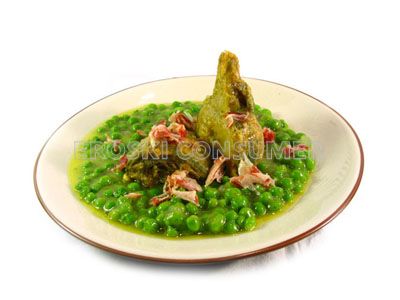
Alcachofas con guisantes


INGREDIENTES
 (4 personas)

8 alcachofas.
150 gramos de guisantes congelados.
50 gramos de jamón cocido.
6 cucharadas de aceite.
½ limón.
2 ramilletes de perejil.
1 diente de ajo.
Sal.


PREPARACIÓN:
Eliminamos las puntas de las alcachofas y las hojas duras.

Retiramos la pelusa con ayuda de una cucharilla y las remojamos en agua acidulada con el zumo de limón. Las cocemos enteras durante 10 minutos en ese agua con un poco de limón y sal.

Sacamos las alcachofas del caldo de cocción y las refrescamos bajo en chorro de agua fría .

Pasamos las alcachofas por harina y huevo batido y las freímos en una sartén con aceite caliente.

Una vez fritas las alcachofas rebozadas las sacamos de la sartén y las depositamos en una bandeja con papel de cocina para eliminar el aceite exceso de la fritura. Reservamos.

Picamos muy finos el ajo pelado y el perejil, y mezclamos con las 6 cucharadas de aceite.

Agregamos los guisantes congelados, la sal y la pimienta y cocemos durante media hora.

Antes de retirar del fuego las verduras, echamos el jamón troceado, las alcachofas rebozadas, el perejil picado y damos un calentón al conjunto.


COMENTARIO NUTRICIONAL:

Las alcachofas son una de las verduras más empleadas para elaborar menestras o para acompañar con otras verduras. Son ricas en vitaminas, minerales y fibra, y contienen una buena cantidad de agua por lo que su contenido calórico es bajo. En este caso, las alcachofas se acompañan de guisantes que van a aportar al plato una buena cantidad de hidratos de carbono complejos.

Para completar la preparación del plato y darle un toque de color y sabor se añade jamón cocido que además va a aportar también proteínas de alto valor biológico.

miércoles, 13 de enero de 2010

Gran ensalada americana de papas


Tiempo de preparación: 30 min.
Tiempo total: 2 h 30 min.
Rinde: 8 porciones de 1/2 taza cada una


INGREDIENTES

  • 1/2 taza de mayonesa KRAFT Real Mayo Mayonnaise

  • 1 cucharada de mostaza amarilla

  • 1/2 cucharadita de semillas de apio
  • 1/2 cucharadita de sal

  • 1/8 cucharadita de pimienta

  • 4 tazas de papas rojas picadas en cubitos, cocidas

  • 2 huevos duros, picados

  • 1 cebolla picada

  • 2 tallos de apio, rebanados

  • 1/3 taza de condimento de pepinillos dulces al eneldo


ELABORACIÓN

Mezcla los primeros 5 ingredientes en un tazón grande.

Agrega los ingredientes restantes; mézclalos ligeramente.

Refrigera la ensalada varias horas o hasta que se enfríe.


CONSEJOS DE COCINAS KRAFT
Cómo servir
Para preparar una excelente comida de verano, sirve esta clásica ensalada de papas con pechugas de pollo asadas y una ensalada de fruta fresca.

Variante
Sustituye la mostaza amarilla por mostaza Dijon GREY POUPON Dijon Mustard y utiliza condimento de pepinillos dulces CLAUSSEN Sweet Pickle Relish.

Cómo picar los huevos duros
Deja que se enfríen y colócalos horizontalmente en el rebanador de huevos. A continuación, córtalos con la hoja rebanadora. Mantén las rebanadas juntas y pon el huevo paradito para poder cortarlo otra vez con el rebanador. O si no, sírvete de un cuchillo pequeño para cortar los huevos duros ya fríos en rebanadas delgadas y, a continuación, cortar cada una de las rebanadas transversalmente en ambas direcciones varias veces hasta terminar de picarlas.

Fuente: Comida Kraft

jueves, 24 de septiembre de 2009

Pepinos rellenos


Simples y MA-RA-VI-LLO-SOS


INGREDIENTES:
Pepino.
Queso crema, tipo Philadelphia.
Unas hojas de menta


ELABORACIÓN:
Se cortan los pepinos en trozos de unos cuatro dedos de altura. Se vacia su contenido sin llegar al fondo, y se reserva la pulpa. Se hacen cortes en la parte superior de cada trozo de pepino de forma que parezca una corona.

Se mezcla bien el queso crema con parte de la pulpa del pepino, muy picadita, y la menta, también muy picada.

Se rellenan los pepinos y se decora con unas hojas de menta.


Receta tomada de Sopa de cocodrilo

martes, 7 de julio de 2009

Buffet de bocados fríos

Ideas para un buffet espléndido

Está tan bien presentado en el blog Sopa de Cocodrilo que no vale la pena transcribirlo.

Enjoy it!
.
.
.

domingo, 2 de noviembre de 2008

Tabuleh (Ensalada de Cous-cous)

Ingredientes
2 tazas de cous-cous
2 tazas de agua
1/2 cebolla
1 zanahoria
2 tomates
20 aceitunas sin hueso
1/2 taza de aceite de oliva
1/2 taza de zumo de limón
un ramillete de perejil fresco
un ramillete de hierbabuena o de menta (opcional)
sal y pimienta


Preparación
Primero hacemos el couscous para que se vaya enfriando una vez cocido. Tradicionalmente es cocido al vapor, pero es facil encontrar couscous precocido cuya preparación es muy sencilla:

Ponemos en un recipiente amplio las 2 tazas de couscous. Calentamos la misma cantidad de agua salada y, cuando hierva, la añadimos al recipiente de la sémola y lo tapamos. Dejamos reposar unos 5 minutos y removemos para asegurarnos que absorve toda el agua. Echamos un chorrito de aceite y removemos para que el grano quede suelto.

Añadimos el zumo de limón y el aceite al recipiente del couscous, salpimentamos y dejamos enfriar.

Mientras se va enfriando, picamos finamente el perejil, la hierbabuena (o la menta) y la cebolla; cortamos en cuadraditos pequeñitos los tomates, la zanahoria y las aceitunas.

Mezclamos todos los ingredientes y dejamos enfriar en la nevera, para servirlo fresquito

Tips
Para quitar el picor de la cebolla podemos, una vez picada, dejarla sumergida en una mezcla de agua y vinagre (o limón) durante la preparación de la ensalada y al final añadirla, lavada y escurrida, a la fuente.

Es un primer plato ideal para acompañr con un segundo de legumbres.

Receta de Vegetarianismo.net

Zapallitos Salteados

Para cocinar de apuro, en cinco minutos se pueden preparar. Justo lo que necesito hoy :p


Tiempo de preparación: 5 minutos
Tiempo de cocción: 10 minutos

Ingredientes (para 4 personas)
6 zapallitos
4 cebollas
1 caldito de verdura
2 cucharada de aceite
4 huevos
4 cucharadas de queso rallado
Salsa de soja (optativo)


Preparación
1.Cortar en tiritas los zapallitos y las cebollas.
2.En una sartén colocar 1/2 taza de agua, disolver el caldito de verdura y, cuando hierva, colocar los zapallitos y las cebollas picadas.
3.Cuando ya estén prácticamente cocidos, agregar una cucharada de aceite y un poco de salsa de soja.
4.Pasar los huevos por agua, y una vez cocidos, verter en las verduras. Se bate todo y se sirve. Condimentar con queso rallado.


Receta de Cheeef.com (site que me encanta porque calcula la cantidad de los ingredientes en función de la cantidad de personas para las que queramos cocinar)